How secure are your passwords?
With Cyber Crime being the No.1 crime reported in the UK, how we choose our passwords
is becoming more important. With a recent study from The Nation Cyber Security Center (NCSC) saying that 15% of people use their pets' names, 14% use a family members'
name and 13% using a notable date.
Even more worryingly 6% of people still use "password" as their password or part of it.
The NSCS have urged people to choose 3 random unconnected words as a base for their passwords and have advised adding numbers and special characters as well.
For example, a strong password would look something like this - P1tpe4met&363 (the 3 words are pit, pea and met)
The password consists of 12 characters (numbers, uppercase and lowercase letters and a special symbol) and also has numbers substituted for letters. As a minimum I would advise
everyone to have a 12-character password in this format but the longer the password is and the better the complexity, the less chance there is of it being cracked.
Why do passwords need to be so complex?
The reason for this is detailed in the chart below. This chart is based on cracking passwords
held in Microsoft Windows for user authentication when you log in (NTLM Hash).
The chart shows how long it would take
a hacker using a rented server from Amazon Web Services for £18 per hour to crack different complexities of passwords.
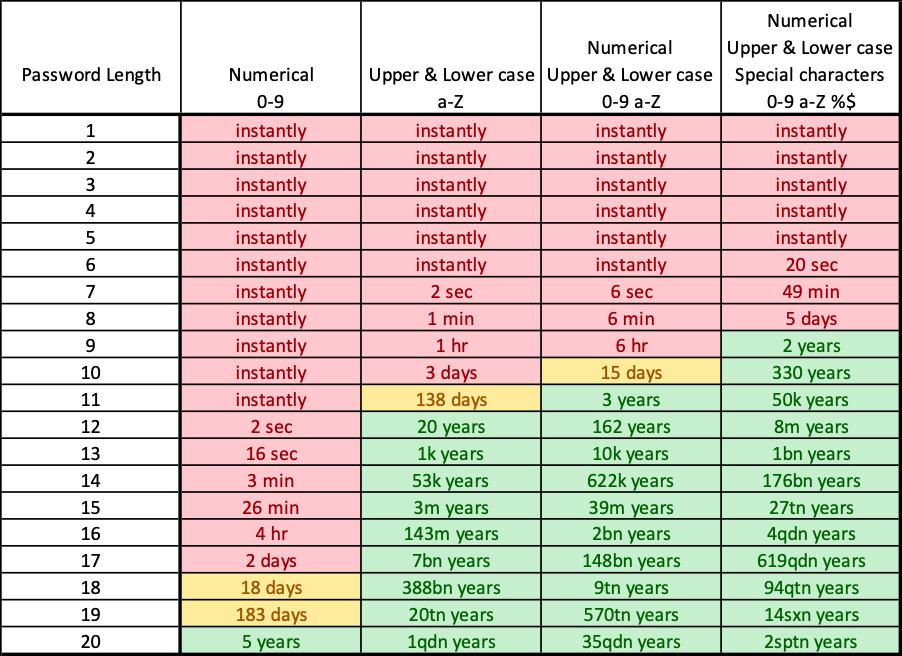
As you can see even 8-character passwords with some complexity would only last a matter of days.
So...
think about the passwords you use and how they would stand up to a hacker.
There are also other things that can be done to help keep your information
safe like using multi-factor authentication whenever possible, using security software and devices to keep you home/office computers and network
safe and enabling some built in Microsoft Windows features.
I will address all these other options in another post.
Author: Matthew Wilkinson-Foster - Email
